Rafael Griffin · 28 October 2026
Daily Temperature Swings in Floating Dock Anchors Accelerate Corrosion Through Salinity Variations in Sheltered Bays
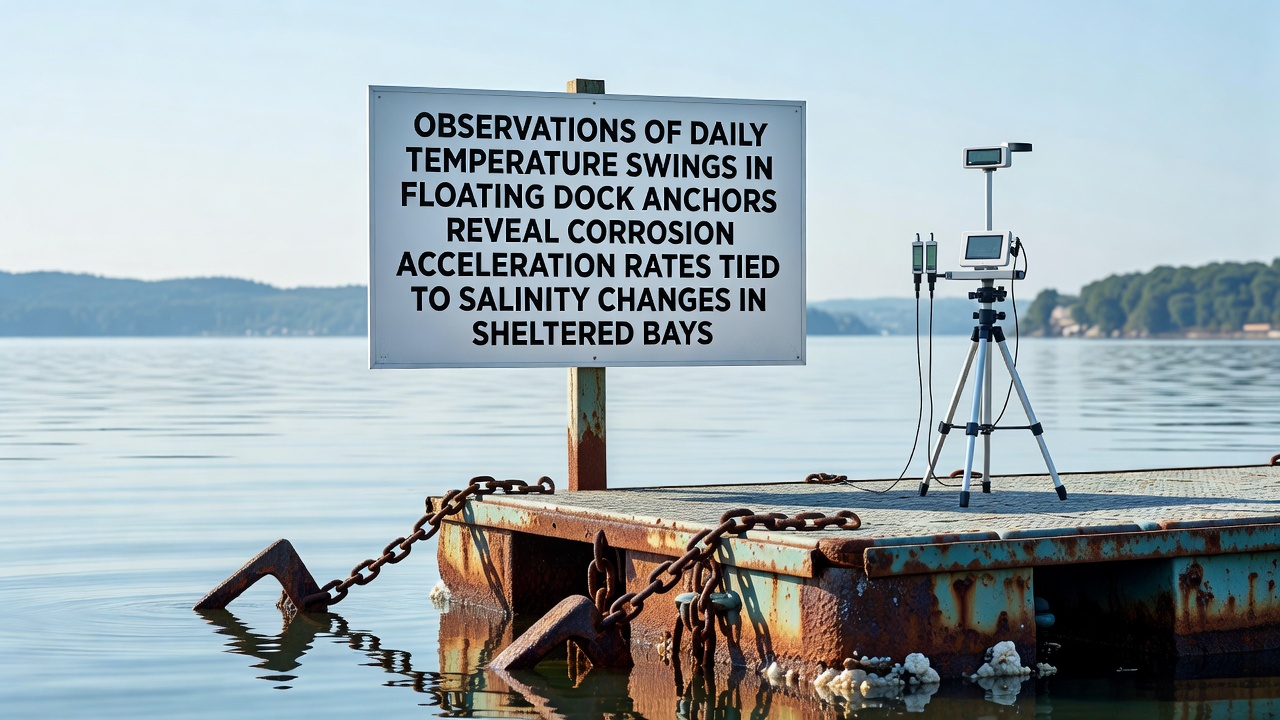
Monitoring programs along sheltered coastal areas have documented how daily temperature swings in floating dock anchors correlate with faster corrosion when salinity levels fluctuate. Researchers track these patterns through embedded sensors that record both thermal cycles and water chemistry at multiple depths.
Measurement Approaches in Coastal Settings
Teams deploy arrays of thermistors and conductivity probes directly on anchor chains and flotation units to capture hourly data. These instruments record temperature ranges that often exceed 10 degrees Celsius within a 24-hour period in shallow sheltered bays, while salinity shifts occur as freshwater inflows mix with tidal seawater. Data from such installations shows that corrosion rates increase when peak daytime temperatures coincide with rising salt concentrations, because the electrochemical reactions on metal surfaces accelerate under those combined conditions.
Studies conducted through 2025 and into October 2026 continue to refine these correlations by comparing sheltered sites with more exposed locations. In protected bays the reduced wave action allows stratified water layers to persist longer, which extends the duration that anchors experience high-salinity conditions during warmer parts of the day.
Corrosion Processes Linked to Environmental Cycles
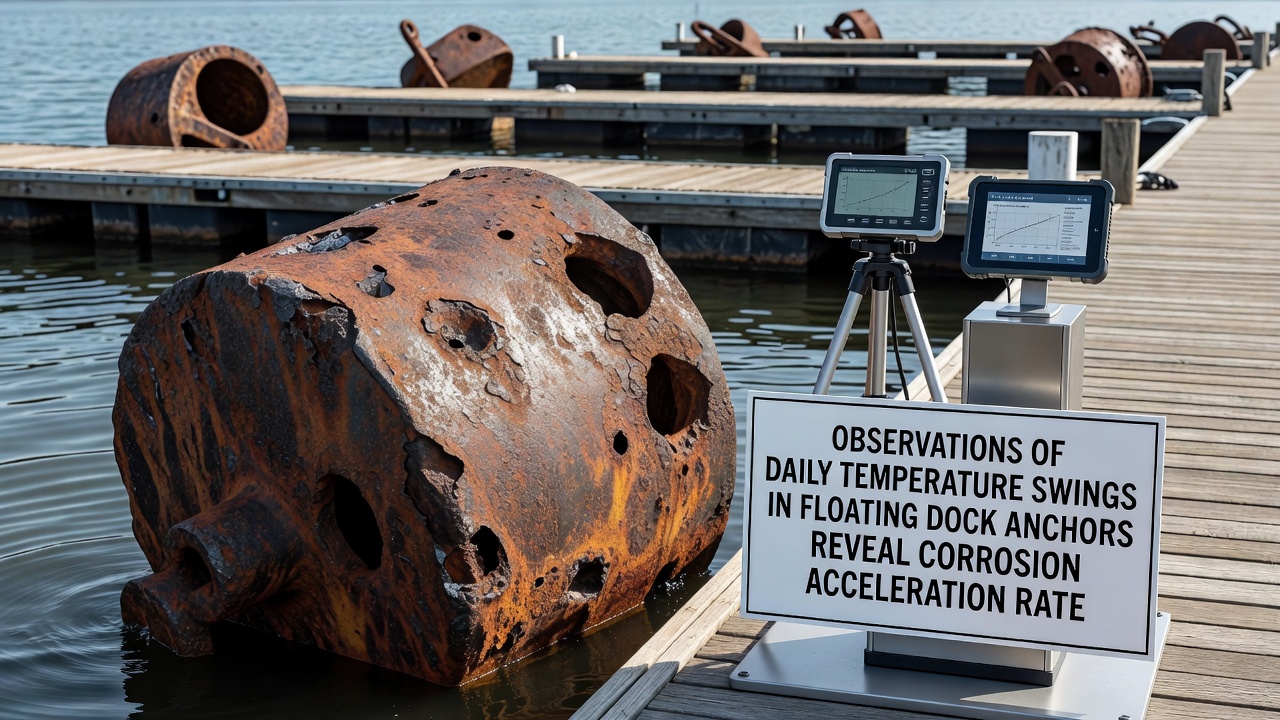
Steel and galvanized components in dock anchors undergo oxidation that speeds up when surface temperatures climb and dissolved salts increase conductivity in surrounding water. Observers note that each daily warming phase expands microscopic cracks already initiated by prior corrosion, while the accompanying salinity spike supplies more chloride ions that penetrate protective oxide layers. Laboratory simulations replicate these field conditions and confirm that the combined stressors produce measurable mass loss several times higher than constant-temperature, constant-salinity tests.
One research group monitoring a series of marinas recorded average corrosion penetration depths of 0.8 millimeters per year on anchor rods exposed to pronounced daily swings, compared with 0.3 millimeters per year at sites where temperature and salinity remained more stable. Those figures come from ultrasonic thickness surveys performed at six-month intervals and cross-checked against weight-loss coupons retrieved from the same locations.
Regional Data Sets and Recent Observations
Long-term records maintained by marine research institutions reveal seasonal peaks in corrosion activity during late summer and early fall when solar heating maximizes daily temperature amplitudes. In October 2026 several monitoring stations along the Pacific and Atlantic coasts reported sustained salinity increases of 3 to 5 practical salinity units during afternoon high tides, coinciding with temperature peaks that pushed anchor surfaces above 28 degrees Celsius. These episodes produced measurable spikes in corrosion current density logged by in-situ electrochemical probes.
According to information published by the National Oceanic and Atmospheric Administration, variations in coastal salinity often trace to changes in precipitation, river discharge, and evaporation rates, all of which become more pronounced inside enclosed bays. Separate analyses from European marine laboratories have shown similar temperature-salinity coupling effects on submerged steel structures, reinforcing that the pattern appears across different geographic regions.
Infrastructure Response Strategies
Port authorities and marina operators have begun adjusting inspection schedules to account for periods when daily temperature swings and salinity changes align. Some facilities now apply additional protective coatings during spring months, before summer thermal cycles intensify. Others install sacrificial anodes sized according to site-specific corrosion rates derived from the sensor arrays rather than generic tables. These adjustments rest on quantitative data rather than generalized assumptions about uniform marine environments.
Engineers also evaluate anchor materials with higher chromium content or specialized alloys when planning replacements in bays known for large diurnal temperature ranges. Field trials indicate that such materials reduce penetration rates by 40 percent under the same fluctuating conditions that accelerate standard carbon steel loss.
Conclusion
Continued collection of temperature, salinity, and corrosion metrics in sheltered bays supplies the factual basis for predicting service life of floating dock anchors. The documented link between daily thermal cycles and salinity-driven acceleration allows maintenance programs to target interventions at the times and locations where material loss occurs most rapidly. Ongoing sensor networks and periodic structural assessments provide teh objective measurements needed to refine these predictions as conditions evolve.